Design of an AI-Driven Personal Health Assistant System for Efficient Management of Chronic Diseases.
Design of an AI-Driven Personal Health Assistant System
DOI:
https://doi.org/10.54117/7zs53k68Keywords:
Chronic diseases, Support system, Artificial intelligence, UML, Design modelAbstract
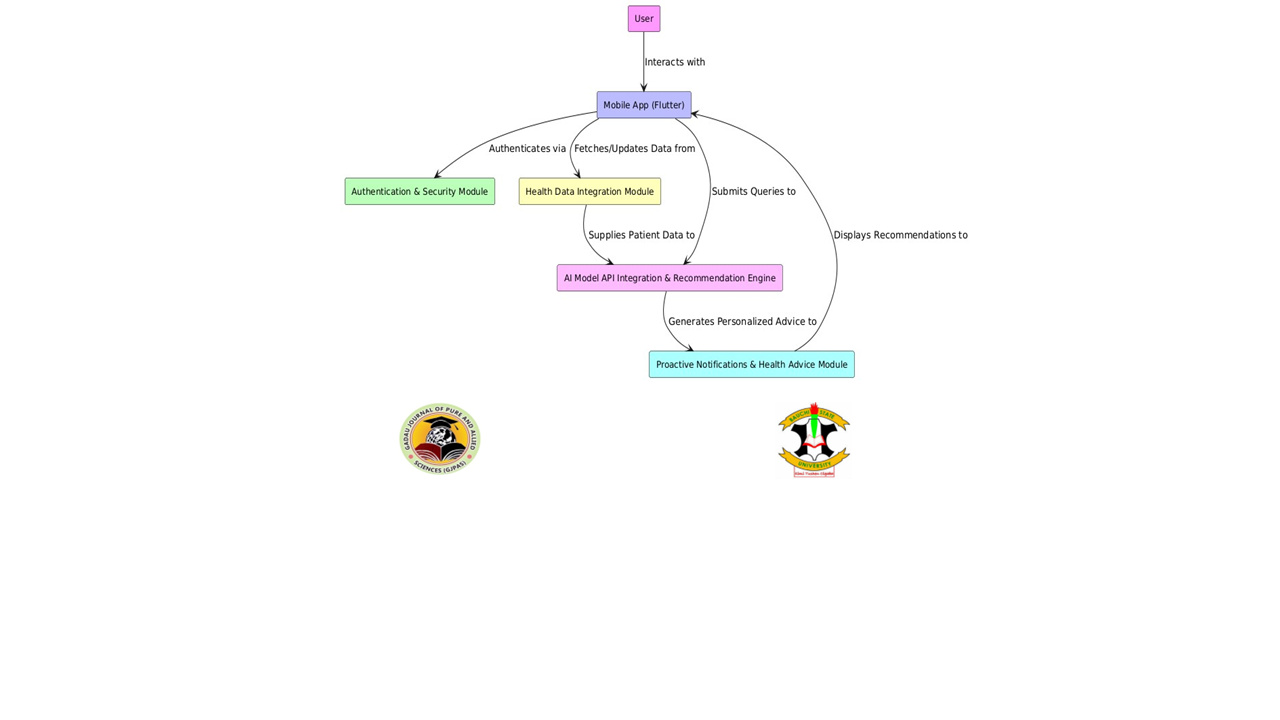
Due to the increasing rates and the overwhelming burdens of chronic diseases, there is an urge for creating an innovation and intelligent health care support systems and management solutions. Chronic diseases, such as diabetes, hypertension, asthma, and cancer, among others, are life-threatening; therefore, they need continued monitoring and long-term care. This paper focuses on presenting an AI-driven personal health assistant design which intended to improve the efficient management of chronic diseases. The research demonstrates the application of artificial intelligence techniques in seamless health monitoring, personalized advice, and an informed decision-making for the patient and the healthcare provider. In order to gain a structured and detailed system design, we applied Unified Modelling Language (UML) diagrams which include: use-case, class, sequence, and activity modeling. These set of diagrams were used in the modeling of system requirements, architecture, and interactions. In addition, a number of consistency checks were carried out on the interrelationships of the designs. Findings from the system design reveals that they are logically consistent and that there is no ambiguity in terms of clarity of function since this act as a frame to guide the actual implementation later. The framework also helps to realize the potentials of AI-driven solutions, particularly in the areas of improving patient self-management, optimizing health care delivery, and reduction in the burdens involved in the course of managing chronic diseases.
References
Almufareh, M. F., Kausar, S., Humayun, M., & Tehsin, S. (2024). A conceptual model for inclusive technology: advancing disability inclusion through artificial intelligence. Journal of Disability Research, 3(1),
Arnold, A., Kolody, S., Comeau, A., & Miguel Cruz, A. (2024). What does the literature say about the use of personal voice assistants in older adults? A scoping review. Disability and Rehabilitation: Assistive Technology, 19(1), 100-111.
Arefin, S. (2024). Chronic disease management through an AI-powered application. Journal of Service Science and Management, 17(4), 305-320.
Bobet, D., & Shabir, G.(2024). The Future of Chronic Disease Management: AI-driven Healthcare and Predictive Analytics.
Batista, A. S. (2025). The transforming clinical practice: The role of AI-powered medical assistants in enhancing healthcare efficiency and decision-making. Journal of Next-Generation Research 5.0.
Danda, R. R., & Dileep, V. (2024). Leveraging AI and Machine Learning for Enhanced Preventive Care and Chronic Disease Management in Health Insurance Plans. Frontiers in Health Informatics, 13(3).
Dong, C., Ji, Y., Fu, Z., Qi, Y., Yi, T., Yang, Y. & Sun, H. (2025). Precision management in chronic disease: an AI empowered perspective on medicine-engineering crossover. Iscience, 28(3).
Donadello, I., & Dragoni, M. (2022). AI-enabled persuasive personal health assistant. Social Network Analysis and Mining, 12(1), 106.
Du, Y., Yang, P., Liu, Y., Deng, C., & Li, X. (2025). Artificial intelligence in chronic disease self-management: current applications and future directions. Frontiers in Public Health, 13, 1689911.
Feng, G., Weng, F., Lu, W., Xu, L., Zhu, W., Tan, M., & Weng, P. (2025). Artificial intelligence in chronic disease management for aging populations: A systematic review of machine learning and NLP applications. International Journal of General Medicine, 3105-3115.
Gupta, N. (2025). AI-Driven Chronic Disease Management: Real-Time Machine Learning Solutions for Diabetes, Hypertension, and Asthma. In 2025 International Conference on Advances in Modern Age Technologies for Health and Engineering Science (AMATHE) (pp. 1-5). IEEE.
Hwang, M., Zheng, Y., Cho, Y., & Jiang, Y. (2025). AI applications for chronic condition self-management: scoping review. Journal of medical Internet research, 27, e59632.
Igwama, G. T., Olaboye, J. A., Cosmos, C., Maha, M. D. A., & Abdul, S. (2024). AI-powered predictive analytics in chronic disease management: Regulatory and ethical considerations. International Journal of Engineering Research and Advanced Development, 20(7), 405-410.
Khan, A. O. R., Islam, S. M., Sarkar, A., Islam, T., Paul, R., & Bari, M. S. (2024). Real-time predictive health monitoring using AI-driven wearable sensors: Enhancing early detection and personalized interventions in chronic disease management. International Journal for Multidisciplinary Research, 6(5), 1-21.
Kumar, M. (2024). Ai-powered wearables for continuous patient monitoring: improving chronic disease management and preventive care. Int Sci J Eng Manag [Internet], 1, 1-8.
Kurniawan, M. H., Handiyani, H., Nuraini, T., Hariyati, R. T. S., & Sutrisno, S. (2024). A systematic review of artificial intelligence-powered (AI-powered) chatbot intervention for managing chronic illness. Annals of Medicine, 56(1),
Murmu, A. A., Jayakrishnan, B., Singh, B., & De, A. (2025). AI-Assisted Diagnosis Patterns in Chronic Illness Management. European Journal of Cardiovascular Medicine, 15, 46-50.
Mbanugo, O. J. (2025). AI-enhanced telemedicine: A common-sense approach to chronic disease management and a tool to bridging the gap in healthcare disparities. Department of Healthcare Management & Informatics, Coles College of Business, Kennesaw State
Mondal, R., Maity, P., Majumder, S., Chowdhury, S., Das, A., & Panda, T. S. (2025, July). AI-Driven Personal Health Assistants:
Transforming Reactive Care into Preventive Healthcare Solutions. In 2025 International Conference on Engineering Innovations and Technologies (ICoEIT) (pp. 1105-1108). IEEE. https://ieeexplore.ieee.org/abstract/document/11211672/
Pan, M., Li, R., Wei, J., Peng, H., Hu, Z., Xiong, Y., & Liu, H. (2025). Application of artificial intelligence in the health management of chronic disease: bibliometric analysis. Frontiers in Medicine, 11, 1506641.
Singareddy, S., Sn, V. P., Jaramillo, A. P., Yasir, M., Iyer, N., Hussein, S., & Nath, T. S. (2023). Artificial intelligence and its role in the management of chronic medical conditions: a systematic review. Cureus, 15(9).
Siau, K., & Rossi, M. (2011). Evaluation techniques for systems analysis and design modelling methods–a review and comparative analysis. Information systems journal, 21(3), 249-268.
Vijay, L., & Kumar, T. (2024). AI-Driven Advancements: Optimizing Chronic Disease Care Through Personal Health Record.
Management. In International Conference on Business and Technology (pp. 355-364). Cham: Springer Nature Switzerland.
Wang, B., Asan, O., & Zhang, Y. (2024). Shaping the future of chronic disease management: Insights into patient needs for AI-based homecare systems. International journal of medical informatics, 181, 105301.
Wang, X., & Wang, Y. (2024). Analysis of trust factors for AI-assisted diagnosis in intelligent healthcare: personalized management strategies in chronic disease management. Expert Systems with Applications, 255, 124499.
Downloads
Published
Issue
Section
License
Copyright (c) 2025 Gadau Journal of Pure and Allied Sciences

This work is licensed under a Creative Commons Attribution 4.0 International License.