Machine Learning Based Classification of Student Academic Performance Using Subject Scores: A Comparative Evaluation of Decision Tree, Naïve Bayes, and Support Vector Machine.
Machine Learning Based Classification of Student Academic Performance
DOI:
https://doi.org/10.54117/77nsha92Keywords:
Educational data mining, Student academic performance, Machine learning; Decision Tree, Naïve Bayes, Support Vector Machine, Academic risk classification, learning analytics, Early warningAbstract
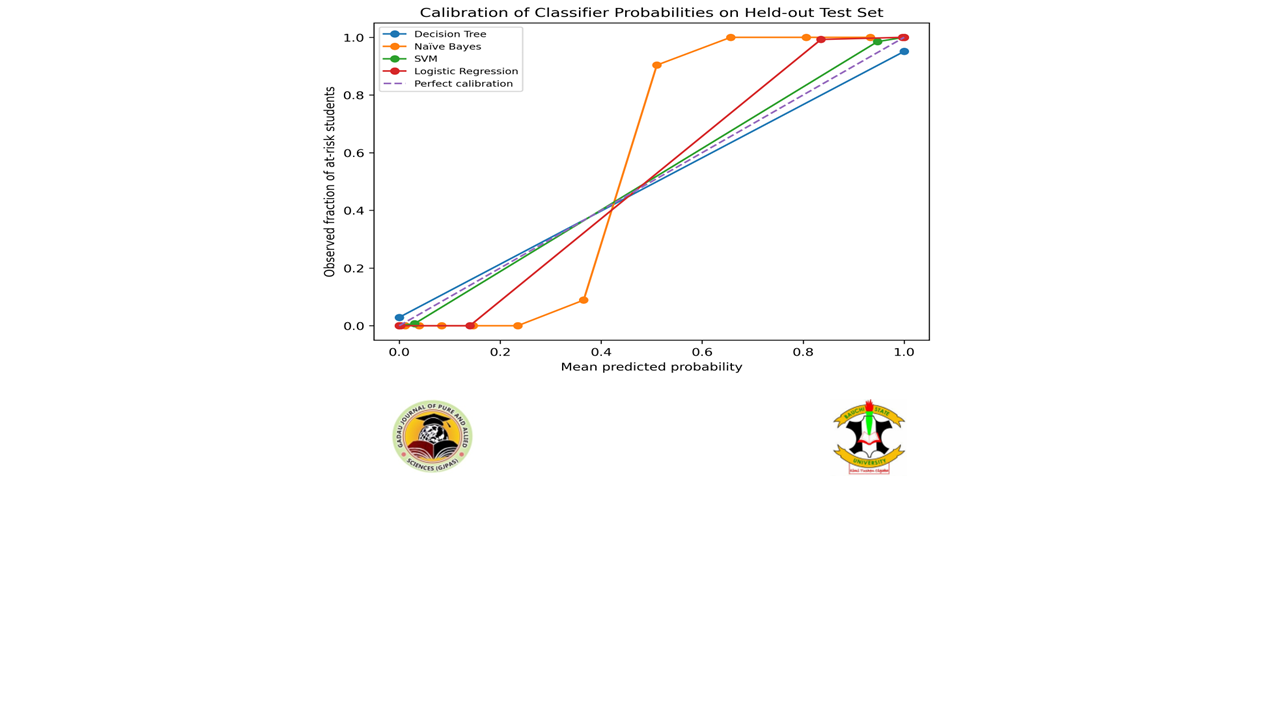
Student academic performance classification is an important application of educational data mining because reliable classification can help institutions organize academic monitoring, identify students whose observed achievement is below an institutional threshold, and support evidence informed academic decision making. This study presents a reproducible comparative evaluation of three supervised machine learning algorithms Decision Tree, Gaussian Naïve Bayes, and Support Vector Machine (SVM) using a supplied dataset containing 9,000 student records and three numeric subject score variables: Mathematics, Physics, and Chemistry. The original categorical grade labels were transformed into a binary academic risk target in which grades D and F represented the at-risk class, while A+, A, B+, B, and C represented the not at-risk class. Personal identifiers and non-predictive descriptive fields were excluded from modelling. The dataset was divided into stratified training and held out test sets using a 70:30 split with random state 42, and ten-fold stratified cross validation was performed on the training data. On the held-out test set, the Decision Tree achieved 96.30% accuracy, 95.11% precision, 95.64% recall, and 95.37% F1 score; Naïve Bayes achieved 95.96% accuracy, 100.00% precision, 89.89% recall, and 94.68% F1 score; and SVM achieved 99.59% accuracy, 99.91% precision, 99.07% recall, and 99.49% F1 score. The corresponding mean ten-fold cross validation accuracies were 96.60%, 95.71%, and 99.54%, respectively. SVM therefore produced the strongest classification performance in this experiment. However, the exceptionally high performance must be interpreted carefully because the supplied grade label is strongly determined by the same subject scores used as predictors. Consequently, the experiment is best understood as a comparative classification study rather than validation of a prospective early warning system. The paper identifies this target leakage issue explicitly and proposes a future longitudinal early warning design using information available before the outcome is determined.
References
Abu Saa, A., Al Emran, M., & Shaalan, K. (2019). Factors affecting students’ performance in higher education: A systematic review of predictive data mining techniques. Technology, Knowledge and Learning, 24, 567–598.
Al Din, M. S. N., & Al Abdulqader, H. A. (2024). Students’ academic performance prediction using educational data mining and machine learning: A systematic review. International Journal of Research and Innovation in Social Science, 8(8), 1264–1291.
Chen, J., Zhou, X., Yao, J., & Tang, S.-K. (2025). Application of machine learning in higher education to predict students’ performance, learning engagement and self-efficacy: A systematic literature review. Asian Education and Development Studies, 14(2), 205–240. https://doi.org/10.1108/AEDS-08-2024-016
Baker, R. S., & Inventado, P. S. (2014). Educational data mining and learning analytics. In J. A. Larusson & B. White (Eds.), Learning Analytics: From Research to Practice (pp. 61–75). Springer.
Hu, Y. H., Lo, C. L., & Shih, S. P. (2014). Developing early warning systems to predict students’ online learning performance. Computers in Human Behavior, 36, 469–478. https://doi.org/10.1016/j.chb.2014.04.002
Pan, J., Zhao, Z., & Han, D. (2025). Academic performance prediction using machine learning approaches: A survey. IEEE Transactions on Learning Technologies, 18, 351–368. https://doi.org/10.1109/TLT.2025.3554174
Macfadyen, L. P., & Dawson, S. (2010). Mining LMS data to develop an “early warning system” for educators: A proof of concept.
Computers & Education, 54(2), 588–599.
Marbouti, F., Diefes Dux, H. A., & Madhavan, K. (2016). Models for early prediction of at risk students in a course using standards based grading. Computers & Education, 103, 1–15. https://doi.org/10.1016/j.compedu.2016.09.005.
Oppong, S. O. (2023). Predicting students’ performance using machine learning algorithms: A review. Asian Journal of Research in Computer Science, 16(3), 128–148. https://doi.org/10.9734/ajrcos/2023/v16i3351.
Siemens, G., & Gašević, D. (2012). Guest editorial—Learning and knowledge analytics. Educational Technology & Society, 15(3), 1–2.
Zhang, Y., Yun, Y., An, R., Cui, J., Dai, H., & Shang, X. (2021). Educational data mining techniques for student performance prediction: Method review and comparison analysis. Frontiers in Psychology, 12, 698490.
Downloads
Published
Issue
Section
License
Copyright (c) 2025 Gadau Journal of Pure and Allied Sciences

This work is licensed under a Creative Commons Attribution 4.0 International License.