Comparative Phytochemical Screening and In-vitro Antioxidant Activity of Artocarpus heterophyllus leaf extract versus Camellia sinensis (Green Tea): Implications for a tea-like herbal infusion
Comparative Phytochemical Screening
DOI:
https://doi.org/10.54117/4per6d53Keywords:
Artocarpus heterophyllus, Camellia sinensis, Antioxidant activity, DPPH, Hydrogen peroxide scavenging, HPLC fingerprintAbstract
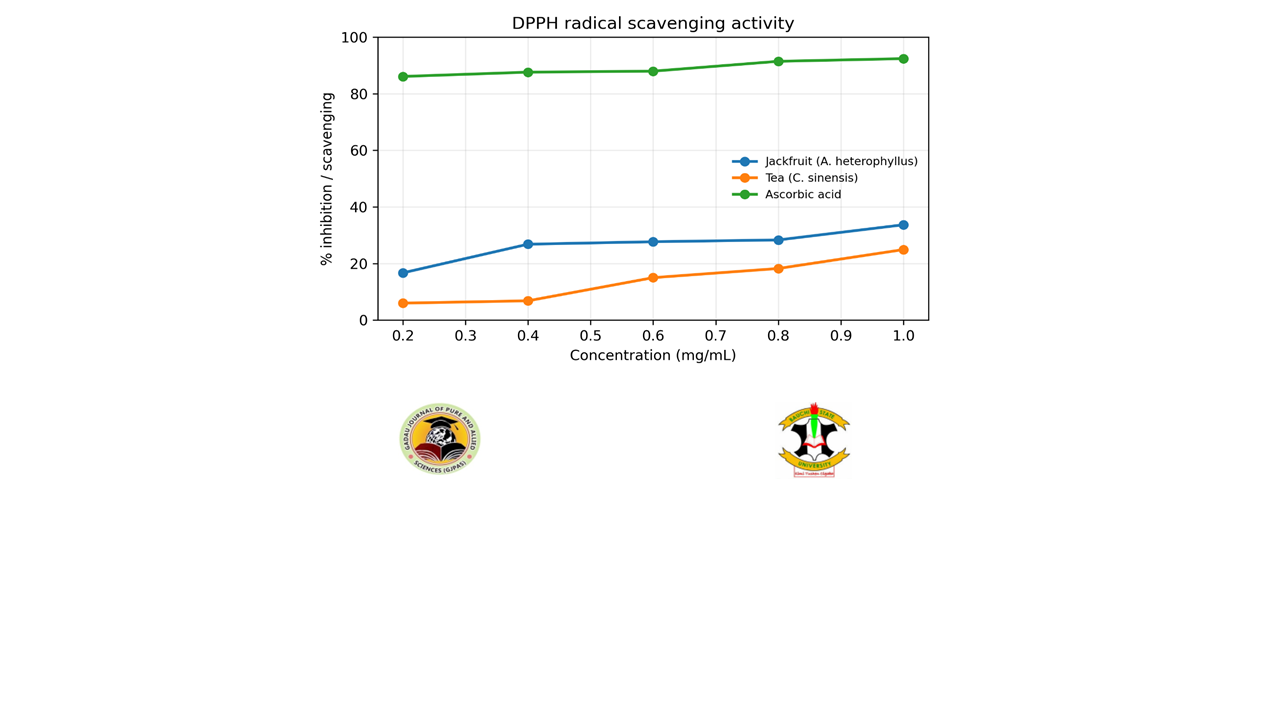
In this study we compared the phytochemical screening and in-vitro antioxidant activities of Artocarpus heterophyllus leaf extract against those of Camellia sinensis (Green Tea) to see the implications or potentials or tea-like herbal infusion of A. heterophyllus Extracts were obtained from the dried leaves of the two teas/samples/ and the extracts were evaluated by qualitative phytochemical screening; in vitro antioxidant activity using DPPH and hydrogen peroxide scavenging assays; amino acid profiling of leaf hydrolysates; and HPLC-DAD fingerprinting, samples tested positive for phenols, tannins, flavonoids and saponins in qualitative screening. In the antioxidant assays (0.2–1.0 mg/mL), A. heterophyllus exhibited higher DPPH and H2O2 scavenging than C. sinensis at the tested concentrations, while ascorbic acid showed the highest activity. Because neither plant extract reached 50% inhibition in the tested range, IC50 values could not be reliably estimated (IC50 > 1.0 mg/mL). Amino acid profiling showed a mixture of essential and non-essential amino acids in both leaf hydrolysates. However, this analysis does not directly reflect infusion chemistry. Jackfruit leaves contain UV-active constituents and show measurable in vitro antioxidant activity, supporting further study as a tea-like herbal infusion. Nevertheless, claims that A. heterophyllus is an alternative to C. sinensis should be limited until tea-defining markers (Epigallocatechin gallate (EGCG), Epigallocatechin (EGC), Epicatechin gallete (ECG), caffeine and theanine) are quantified using validated chromatographic methods (like., ISO 14502-2).
References
Ajala, O., English, P., & Pinkney, J. (2013). Systematic review and meta-analysis of different dietary approaches to the management of type 2 diabetes The American journal of clinical nutrition, 97(3), 505-516.
AOAC (Association of Official Analytical Chemicals) (2006) Official Method ofAnalysis of the AOAC (W. Horwitz Editor Eighteen Edition, Washington; D. C., AOAC.
AOAC (2005). Amino acids in feeds performic acid oxidation with acid hydrolys is sodium metabisulfite method. AOAC Official Method.
AOAC (2012). Determination of labeled fatty acids content in milk products and infant formula Capillary Gas Chromatography, AOAC Official Method.
Barclay, A. W., Petocz, P., Mc Millan-Price, J., Flood, V. M., Prvan, T., Mitchell, P., & Brand- Miller, J. C. (2008). Glycemic index, glycemic load, and chronic disease risk—a meta- analysis of observational studies. The American journal of clinical nutrition, 87(3), 627- 637.
Benitez, L.V. (1989). Amino Acid and fatty acid profiles in aquaculture nutrition studies, p.23-35. in S.S. De Silva (ed.) Fish Nutrition Research in Asia. Proceedings of the Third Asian Fish Nutrition Network Meeting Asian fish, Society Special Publication.4,166p.
Asian Fisher Society, Manila Philippines.
Clancy, A. K., Woods, K., McMahon, A., & Probst,Y.(2015). Food Composition Database Format and Structure: A User Focused Approach. PLoS One, 10(11), 142-157.
Das, S. K., Gilhooly, C. H., Golden, J. K., Pittas, A. G., Fuss, P. J., Cheatham, R. A., . . . Lichtenstein, A. H. (2007). Long-term effects of 2 energy-restricted diets differing in glycemic load on dietary adherence, body composition, and metabolism in CALERIE: a 1-y randomized controlled trial. The American journal of clinical nutrition, 85(4), 1023- 1030.
Del Rio, D., Rodriguez-Mateos, A., Spencer, J. P., Tognolini, M., Borges, G., & Crozier, A. (2013). Dietary (poly) phenolics in human health: structures, bioavailability, and evidence of protective effects against chronic diseases. Antioxidants & redox signaling,
Engelhardt UH. Tea chemistry What do and what don’t we know? A micro review. Food Research International. 2020; 132:109120.
FAO/WHO (1998). Carbohydrates in human nutrition. Report of a Joint FAO/WHO Expert Consultation. FAO Food Nutr Pap 66, 1–140.
Gansevoort, R. T., Correa Rotter, R., Hemmelgarn, B. R., Jafar, T. H., Heerspink, H. J. L.,Mann, J. F.,Wen, C. P. (2013). Chronic kidney disease and cardiovascular risk: epidemiology, mechanisms, and prevention. The Lancet, 382(9889), 339-352.
Green FM, Catechins T. Nature’s Way of Preventing and Treating Cancer. Int J Mol Sci 2022;23(18).
Hayward,R.A.,Reaven,P.D.,Wiitala,W.L.,Bahn,G.D.,Reda,D.J.,Ge,L.,...Emanuele,N.V.(2015). Follow-up of glycemic control and cardiovascular out comes in type 2 diabetes. New England Journal of Medicine, 372(23), 2197-2206. Helrick, K. (1990). Official methods of analysis: AOAC.
Indrianingsih AW, et al. The effect of extraction method on biological activity and phytochemical content of Artocarpus heterophyllus (jackfruit) leaves extract. Process Biochemistry. 2024; 143:135–147.
ISO 14502-2:2005. Determination of substances characteristic of green and black tea Part 2: Content of catechins in green tea — Method using high-performance liquid chromatography.
Jia Y, Mao Q, Yang J, Du N, Zhu Y, Min W. (-)-Epigallocatechin-3-Gallate Protects Human Skin Fibroblasts from Ul traviolet a Induced Photoaging. Clin Cosmet Investig Dermatol 2023;16:149–59.
Julia, C., Kesse-Guyot, E., Touvier, M., Méjean, C., Fezeu, L., & Hercberg, S. (2014). Application of the British Food Standards Agency nutrient profiling system in a French food composition database, British Journal of Nutrition, 112(10), 1699-1705.
Kan L, Capuano E, Fogliano V, Oliviero T, Verkerk R. Tea polyphenols as a strategy to control starch digestion in bread: the effects of polyphenol type and gluten. Food Funct 2020;11(7):5933–43.
Landry, J., & Delhaye,S. (1992). Simplified procedure for the determination of tryptophan of foods and feed stuffs from barytic hydrolysis. Journal of Agricultural and Food Chemistry, 40, 776–779.
Ley, S. H., Hamdy, O., Mohan, V., & Hu, F. B. (2014). Prevention and management of type 2 diabetes: dietary components and nutritional strategies. The Lancet, 383 (9933), 1999- 2007.
Louie, J. C. Y., Flood, V. M., Atkinson, F. S., Barclay, A. W., & Brand-Miller, J. C. (2015). Methodology for assigning appropriate glycaemic index values to an Australian food composition database. Journal of Food Composition and Analysis, 38, 1-6.
Maiyaki, M. B., & Garbati, M. A. (2014). The burden of non-communicable diseases in Nigeria; in the context of globalization, Annals of African medicine, 13(1), 1-10.
Marrero,S.L., Bloom,D.E.,& Adashi, E.Y. (2012). Non communicable diseases: a global health crisis in a new world order. Jama, 307(19), 2037-2038.
Maziya-Dixon, B., Akinyele, I., Oguntona, E., Nokoe, S., Sanusi, R., & Harris, E. (2004). Nigerian Food Consumption and Nutrition Survey 2001–2003, Summary. International Institute of Tropical Agriculture (IITA), Ibadan, Nigeria.
Murakami, K., Mc Caffrey, T. A., & Livingstone, M. B. E. (2013). Associations of dietary glycaemic index and glycaemic load with food and nutrient intake and general and central obesity in British adults. British Journal of Nutrition, 110(11), 2047-2057.
Organization, W. H., & Unit, W. H. O. M. o. S. A. (2014). Global status report on alcohol and health, 2014: World Health Organization.
Pe R.W., and Gilani, G. S (2005). Chromatographic Determination of Amino Acids in Foods. J. AOAC Int , 88(3) Poti,J.M.,Yoon, E., Hollings worth, B., Ostrowski,J., Wandell ,J., Miles,D.R., & Popkin, B.
M. (2017). Development of a food composition database to monitor changes in packaged foods and beverages. Journal of Food Composition and Analysis.
Probst, Y., Guan, V., & Kent, K. (2018). A systematic review of food composition tools used for determining dietary polyphenol intake in estimated intake studies. Food chemistry, 238, 146-152.
Roman MC, Hildreth J, Bannister S. Determination of catechins and caffeine in Camellia sinensis raw materials, extracts, and dietary supplements by HPLC-UV: Single-laboratory validation. J AOAC Int. 2013;96(5):933–941.
Rothwell, J.A., Perez-Jimenez, J., Neveu,V., Medina-Remon, A., M'Hiri, N.,García-Lobato, P., Wishart, D. S. (2013). Phenol-Explorer 3.0: a major update of the Phenol-Explorer database to incorporate data on the effects of food processing on polyphenol content.
Database, 2013, bat070.
Schiener, P., Black, K. D., Stanley, M. S., & Green, D. H. (2015). The seasonal variation in the chemical composition of the kelp species Laminariadigitata, Laminariahyperborea, Saccharinalatissima and Alariaesculenta. Journal of applied phycology, 27(1), 363-373.
Sun,L.,Lee, D.E.M., Tan,W.J.K., Ranawana,D.V.,Quek,Y.C.R.,Goh, H.J., & Henry,C. J. (2015). Glycaemic index and glycaemic load of selected popular foods consumed in Southeast Asia. British Journal of Nutrition, 113(5), 843-848.
Westenbrink, S.,Brunt,K., & van der Kamp, J.-W. (2013). Dietary fibre: challenges in production and use of food composition data. Food chemistry, 140(3), 562-567.
World Health Organization (WHO). WHO Maps:Non-communicable disease trend in all countries, World Health Global Report, 2014.
Xie LW, Cai S, Zhao TS, Li M, Tian Y. Green tea derivative (-)-epigallocatechin-3-gallate (EGCG) confers protection against ionizing radiation-induced intestinal epithelial cell death both in vitro and in vivo. Free Radic Biol Med 2020; 161:175–86.
Yang G, Meng Q, Shi J, et al. Special tea products featuring functional components: Health benefits and processing strategies. Compr Rev Food Sci Food Saf 2023;22(3):1686–721.
Yalçın, T., Al, A., & Rakıcıoğlu, N. (2017). The effects of meal glycemic load on blood glucose levels of adults with different body mass indexes. Indian journal of endocrinology and metabolism, 21(1), 71.
Yin B, Lian R, Li Z, et al. Tea Polyphenols Enhanced the Antioxidant Capacity and Induced Hsps to Relieve Heat Stress Injury. Oxid Med Cell Longev 2021; 2021:9615429.
Yuniarti L, et al. Comprehensive bioactive compound profiling of Artocarpus heterophyllus leaves: LC–MS/MS analysis and antioxidant potential. Drug Design, Development and Therapy. 2025; 19:1195–1213.
Downloads
Published
Issue
Section
License
Copyright (c) 2025 Gadau Journal of Pure and Allied Sciences

This work is licensed under a Creative Commons Attribution 4.0 International License.